In today's highly competitive business environment, organizations are increasingly relying on data-driven decision-making to stay ahead of competitors.
Traditional reporting tools provide information about what happened in the past. Predictive Analytics Software goes a step further by helping organizations understand what is likely to happen in the future.
Using artificial intelligence, machine learning, advanced statistics, and big data analytics, businesses can forecast trends, identify risks, optimize operations, and improve strategic planning.
For companies across the United States, Canada, Germany, Australia, United Kingdom, Switzerland, Netherlands, France, Belgium, Austria, Spain, Italy, Poland, Romania, South Africa, Brazil, Mexico, and Greece, predictive analytics has become a critical component of enterprise digital transformation strategies.
What Is Predictive Analytics Software?
Predictive Analytics Software is a technology platform that uses historical data, machine learning algorithms, artificial intelligence, and statistical models to forecast future outcomes.
Organizations use predictive analytics to forecast sales, predict customer behavior, optimize inventory, improve financial planning, reduce operational risks, enhance supply chain performance, and improve resource allocation.
Rather than reacting to events after they occur, businesses can make proactive decisions using predictive insights.
Why Predictive Analytics Is Important for Modern Businesses
Every business generates massive amounts of data. Predictive analytics software helps organizations identify future opportunities, reduce uncertainty, improve forecasting accuracy, enhance profitability, and support strategic planning.
Key Benefits of Predictive Analytics Software
1. More Accurate Business Forecasting
Forecast demand, predict revenue growth, estimate future expenses, and anticipate market changes.
2. Better Financial Planning
Improve budget planning, cash flow forecasting, revenue projections, and financial risk management.
3. Improved Operational Efficiency
Optimize workflows, improve staffing plans, allocate resources efficiently, and reduce waste.
4. Risk Management and Compliance
Detect anomalies, identify fraud patterns, forecast compliance risks, and monitor operational threats.
Core Features of Predictive Analytics Software
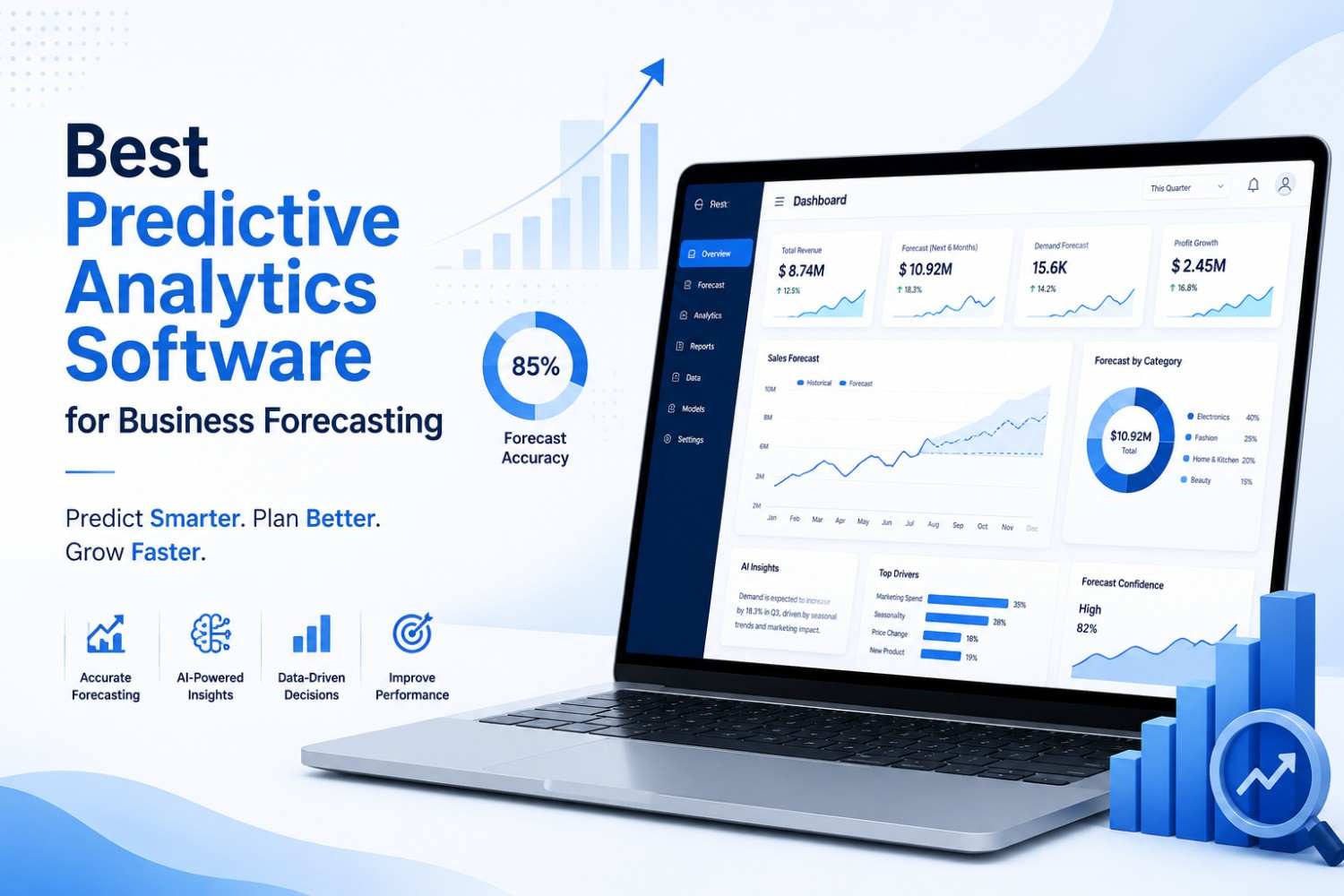
AI-Powered Forecasting
Artificial intelligence enhances forecasting by analyzing large datasets and identifying patterns.
Machine Learning Analytics
Continuously improves predictions over time through automated model optimization and pattern recognition.
Data Visualization and Dashboards
Interactive dashboards, KPI tracking, executive reporting, and trend analysis.
Predictive Modeling Software
Creates statistical models for customer retention analysis, sales forecasting, risk assessment, and inventory optimization.
Predictive Analytics in Key Industries
- Manufacturing: Predictive Maintenance, Demand Forecasting, Inventory Optimization
- Financial Services: Credit risk assessment, Fraud detection, Portfolio management
- Retail & E-Commerce: Customer analytics and demand forecasting
How to Choose the Best Predictive Analytics Software
Organizations should evaluate AI capabilities, integration options (ERP, CRM, BI), reporting features, security, and scalability before selecting a platform.
Predictive Analytics Trends for 2026
- Generative AI Analytics
- Real-Time Predictive Intelligence
- Hyperautomation
- Industry-Specific Analytics Platforms
Frequently Asked Questions
What is Predictive Analytics Software?
Predictive Analytics Software uses historical data, machine learning, and AI to forecast future outcomes.
Why is Predictive Analytics important?
It helps organizations reduce uncertainty, improve forecasting accuracy, and make proactive business decisions.
How does AI improve predictive analytics?
AI enhances pattern recognition, automates model optimization, and improves forecasting accuracy.
Conclusion
Predictive Analytics Software has become one of the most valuable enterprise technologies for organizations seeking better forecasting, stronger decision-making, and improved operational performance.
By combining artificial intelligence, machine learning analytics, business intelligence, and cloud-based scalability, modern predictive analytics platforms help organizations transform data into actionable business insights.
As enterprises continue investing in digital transformation and AI-driven innovation, predictive analytics software will remain a critical component of business strategy throughout 2026 and beyond.